
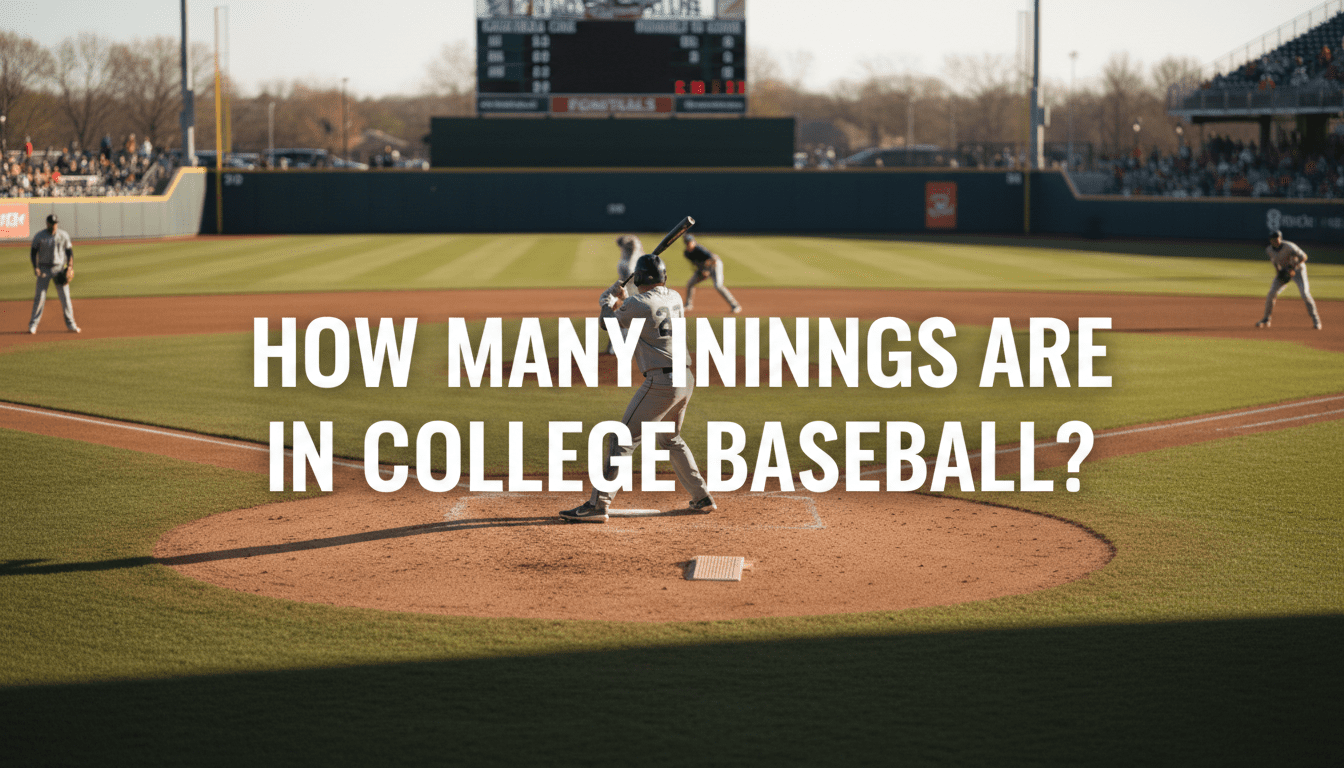
If you follow college baseball, you probably wonder how many innings a game lasts. Knowing this helps you understand the pace of play, plan your time as a fan, and get a better grasp of the strategies teams use. College baseball has its own rules, and innings are one of the main differences compared with professional or high school games.
Innings determine how the game unfolds. Each inning gives both teams a chance to score, and the total number of innings sets the game’s length. Understanding innings helps you follow the action, anticipate key moments, and appreciate the strategy behind pitching and batting decisions.
Understanding Innings in College Baseball
An inning in baseball is a segment of the game where both teams get to bat and field once. In college baseball, an inning starts with one team on offense and the other on defense. The offensive team tries to score runs, and the defensive team tries to get three outs. Once the defensive team records three outs, the teams switch roles.
Each inning has two halves: the top and the bottom. The visiting team bats in the top half, and the home team bats in the bottom half. Knowing this helps you follow the score and understand why the game can swing quickly.
Innings also affect game strategy. Coaches decide when to change pitchers, make substitutions, or play aggressively based on how many innings remain. The number of innings sets the framework for the game, so you can see why it matters to know how long a college baseball game lasts.
How Many Innings Are in a Standard College Baseball Game
College baseball games follow NCAA rules, which set the standard length at nine innings. That means each team gets nine turns to bat and nine chances to field. This differs from high school games, which usually last seven innings, and Major League Baseball, which also uses nine innings.
Most college games finish in nine innings, but a few factors can shorten or extend the game. Weather delays, darkness, and tournament rules can reduce innings. On the other hand, if the score is tied after nine innings, the game goes into extra innings.
Knowing the standard nine-inning structure helps you understand player stats, pitching rotations, and game pacing. You’ll notice teams plan differently depending on whether the game is early in the season, part of a tournament, or a doubleheader.
Extra Innings in College Baseball
When a college baseball game is tied after nine innings, it goes into extra innings. Each extra inning gives both teams another chance to score. The goal is to break the tie, and the game continues until one team leads at the end of a completed inning.
Extra innings can test players’ stamina and strategy. Coaches often adjust their pitching rotation to handle the additional innings. Teams may also take more risks on base running and batting to score quickly. As a fan, you’ll notice the tension rise in extra innings because every pitch and play can decide the game.
College baseball also uses specific rules to speed up extra innings. For example, some tournaments place a runner on second base at the start of each extra inning. This rule increases scoring chances and can shorten the game while keeping it exciting.
Doubleheaders and Adjusted Innings
Doubleheaders are common in college baseball. These occur when a team plays two games in one day, often to make up for postponed games. To manage players’ energy and pitching limits, these games usually run seven innings instead of nine.
Adjusting innings changes strategy. Pitchers have to throw fewer pitches, and coaches may rotate players differently. Teams also plan their offensive approach, knowing they have fewer opportunities to score. If the first game runs long, the second game can feel fast-paced because teams must make every inning count.
Understanding doubleheaders helps you follow the schedule and know why stats or scoring patterns may differ from a standard nine-inning game.
Key Rules Affecting Innings in College Baseball
Several NCAA rules influence innings and game length.
- Run limits (mercy rules) – Games can end early if one team leads by a significant margin after a set number of innings.
• Time constraints – Some tournaments impose time limits to keep schedules on track.
• Weather delays and cancellations – Rain or darkness can shorten a game, sometimes changing its official length.
These rules ensure safety and fairness while keeping the game moving. Knowing them helps you understand why some games finish faster than expected.
Differences Between College Baseball and Other Levels
College baseball differs from professional and high school baseball in several ways:
- Game length – Nine innings in college and MLB, seven in high school.
• Pitching rules – College pitchers have limits to protect arm health.
• Strategy – College coaches may use aggressive tactics to take advantage of extra rules like the runner-on-second extra inning.
If you follow all levels of baseball, you’ll notice college games move faster than MLB but are more structured than high school games. Understanding these differences makes it easier to follow player development and game strategy.
Common Questions About College Baseball Innings
How long does a college baseball game typically last?
A standard nine-inning college game lasts about three hours. Games with extra innings or weather delays can run longer. Pitching pace and team strategy also affect total time, so be prepared for some variation.
Can college baseball games end early?
Yes. NCAA rules allow games to end early under certain conditions. The mercy rule ends games when one team leads by a large margin after a set number of innings. Weather or darkness can also shorten games, sometimes leaving them official after fewer than nine innings.
Conclusion
College baseball games usually last nine innings, giving both teams nine chances to score. Extra innings, doubleheaders, and special rules can shorten or extend games, but the structure remains consistent. Understanding innings helps you follow the game, track strategy, and appreciate the decisions players and coaches make.
Knowing these details makes you a smarter fan, whether you watch from the stands, follow online, or play yourself. When you see a game tied after nine or a doubleheader in progress, you’ll understand why it moves the way it does and what’s at stake in each inning.
